Annual day planning usually lands on an HR manager's desk
alongside everything else they're managing. No dedicated event budget owner, no
internal production team, and a deadline that doesn't move. The brief is broad
— something for 200 to 800 employees, mix of entertainment and recognition,
leadership wants it to feel "premium" — and the planning window is
rarely more than six to eight weeks.
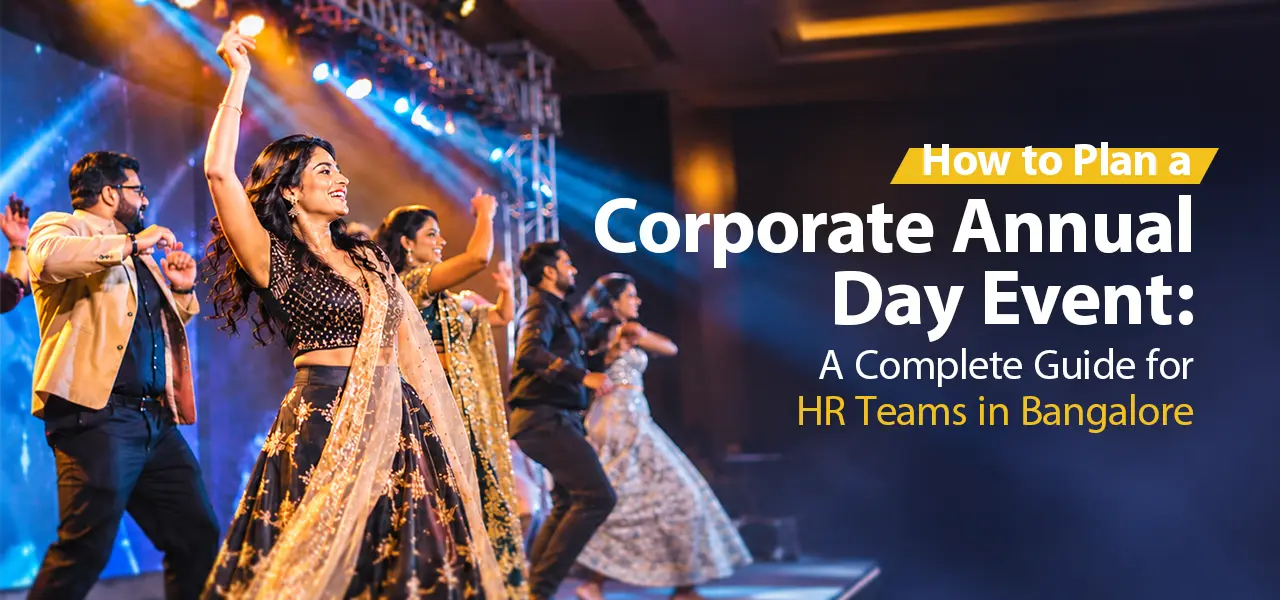
This guide covers how to plan a corporate annual day event
properly — from setting the brief and locking a venue to running the day
without the usual last-minute chaos. It's written for HR managers, admin teams,
and employee engagement leads in Bangalore who are planning a corporate annual day event for the first
time or looking to improve on a previous year.
An annual day is the one event in the corporate calendar where
employees are the primary audience — not clients, not investors. Done well, it
communicates that the company values its people, recognises performance
publicly, and invests in shared experiences that go beyond the work itself.
Done poorly, it's a long evening with weak sound, rushed award calls, and food
that ran out an hour in.
The business case for getting this right is real. Employee engagement events like annual
days directly influence how employees talk about the company — internally and
externally. A well-produced annual day creates content that HR and marketing
teams can use for months: photographs, recognition moments, culture videos. A
poorly executed one produces complaints that circulate quietly for the same
duration.
The companies that run the best annual days treat them as a
strategic communication exercise, not a logistics problem. That shift in
framing changes every planning decision that follows.
The most common annual day planning mistake is booking a venue
before answering the foundational questions. The venue should be the output of
the brief — not the starting point.
Before any vendor is contacted or date is confirmed, the
planning team needs to agree on:
•
What is the primary purpose of this year's annual day —
recognition, culture building, leadership communication, or celebrating a
milestone?
•
Who is the audience — headcount, seniority mix, whether
families are included, whether remote employees are attending
•
What does a successful event look like the morning
after — what should employees be saying or sharing?
•
What went wrong last year, and what specifically needs
to be better?
•
What is the realistic budget, including contingency —
not the ideal budget
These five questions take less than an hour to answer in a
team meeting, and they prevent the majority of problems that show up six weeks
later. An HR team that has answered them properly can brief an event company, a
venue, and an AV vendor in a single document — and get accurate proposals back.
The minimum viable planning window for a corporate annual day
in Bangalore is eight weeks. Ten to twelve is comfortable. Anything under six
weeks means making compromises — usually on venue quality, entertainment, or
both.
8 Weeks Out: Lock the
Foundations
Confirm the date, headcount, and budget range. Begin venue
shortlisting. In Bangalore, premium banquet halls, hotel ballrooms, and
standalone event spaces book up fast — especially on Fridays and Saturdays in
Q3 and Q4. If you're working with an experienced corporate event management company in Bangalore, this is the point to
brief them — not after the venue is booked.
6 Weeks Out: Venue,
Theme, and Core Vendors
Lock the venue with a signed agreement. Finalise the event
theme — this drives every creative decision from stage design to invitation
design. Brief entertainment vendors and begin evaluating options. Send
save-the-date communication to employees.
4 Weeks Out: Programme
Design and Invitations
Finalise the run-of-show: sequence of events, award
categories, entertainment slots, leadership addresses, and the closing moment.
Send formal invitations. Begin collecting award nominations if the process is
internal. Confirm AV, lighting, and stage production requirements with the
venue.
2 Weeks Out:
Confirmations and Rehearsals
Confirm all vendors in writing. Get a final headcount. Prepare
the awards list, scripts, and cue sheets. If there are performers, confirm
their technical requirements and share with the AV team. Organise a production
meeting with all vendors — this single meeting prevents most event-day
miscommunication.
Event Week: On-Ground
Preparation
Venue setup typically begins the day before. Run a full
technical rehearsal with AV, lighting, and any performers. Brief all internal
volunteers or staff assigned to door management, ushering, and registration.
Prepare a single WhatsApp group with all key contacts — venue coordinator, AV
lead, catering manager, and your internal event owner.
Step 1: Set the Objective
and Format
Annual days are not all the same format. A 100-person team
dinner is a different event to a 600-person gala with a stage show, award
ceremony, and celebrity performer. The format should be decided before anything
else — it determines venue size, production scope, and budget allocation.
Common formats in Bangalore:
•
Awards night with entertainment — the most common
format, works for 150 to 1000+ guests
•
Themed gala dinner — entertainment-led, suits companies
with strong culture identity
•
All-day celebration with outdoor activities followed by
an evening programme — works well when families are included
•
Milestone event — a company anniversary or significant
achievement, usually more elevated in production
Step 2: Set the Budget
With Real Numbers
Budget conversations that happen too late create the worst
trade-offs — cutting entertainment to afford the venue, or reducing catering
quality to stay under a total spend. A realistic per-head estimate for a
professionally managed corporate annual day in Bangalore ranges depending on
format, venue tier, and entertainment.
Allocate budget across: venue hire, catering per head, AV and
production, entertainment, décor and stage design, photography and videography,
awards and trophies, invitations and communication, and a contingency of 10 to
15 percent. Most teams underestimate AV and production — it's consistently the
most expensive line item after catering, and the one that has the biggest
impact on how the evening feels.
Step 3: Choose the Right
Venue for Your Headcount and Format
Venue selection in Bangalore is competitive for certain dates.
The city has a strong supply of options — hotel ballrooms in Whitefield,
Koramangala, and the CBD; standalone banquet spaces; resorts on the Mysore Road
and Tumkur Road corridors for larger events. The right venue depends on more
than capacity. Check:
•
Can the stage and AV setup fit within the space without
compromising guest sightlines?
•
Is the parking adequate for your headcount?
•
What is the venue's catering policy — in-house only, or
can you bring an external caterer?
•
What is included in the hire cost, and what is charged
separately?
•
Does the venue have a noise curfew that affects your
programme timing?
Working with a corporate event management company in Bangalore
gives you access to vetted venue relationships and realistic briefings on what
each space can actually deliver — not just what the brochure says.
Step 4: Design the Event
Theme
The theme is the creative brief for every vendor. A clear
theme makes briefing faster, proposals more relevant, and the final event more
cohesive. Themes that work for annual days tend to be either visual (a colour
palette and aesthetic direction) or conceptual (a company milestone, a cultural
reference, a forward-looking idea tied to the company's direction).
Themes that don't work: ones that are too abstract to execute
in décor and entertainment, ones that exclude a large part of the employee
demographic, and ones chosen because they looked good on a Pinterest board but
don't translate to a ballroom.
Step 5: Build the
Run-of-Show
The run-of-show is the minute-by-minute document that everyone
— AV team, MC, venue coordinator, internal leads — works from on the day. It
should include every moment: guest arrival and registration, welcome address,
entertainment slots, award ceremony (with award names, recipients, and
presenter names), dinner service timing, and close.
Common run-of-show mistakes: awards that run too long because
the list wasn't edited, entertainment that starts before dinner is cleared, a
closing moment that fizzles out because nobody planned it specifically. The
best annual days end on a high — a performance, a group moment, a final
address. The worst ones just stop.
Step 6: Plan the
Recognition and Awards Properly
The award ceremony is the centrepiece of most annual days —
and the part that most often goes wrong. Names mispronounced, wrong people
called to stage, delays while trophies are located, a list that runs 45 minutes
longer than scheduled.
Practical fixes: finalise the award list and recipient names
two weeks before the event, share the confirmed list with the MC and AV team in
advance, prepare a cue sheet with names phonetically spelled, assign a
dedicated backstage coordinator to manage trophy handoffs, and brief presenters
separately on their role.
Step 7: Entertainment
That Fits the Room
Entertainment options for corporate annual days in Bangalore
range from live bands and stand-up comedians to cultural performances, DJ sets,
and celebrity appearances. The right choice depends on your employee
demographic, the tone of the event, and the budget. Annual day event organisers with
established vendor networks can help you evaluate acts that have performed well
in similar corporate contexts — which saves significant time and avoids the
risk of booking entertainment that doesn't land with a corporate crowd.
One practical note: entertainment that runs in the middle of
the programme tends to lose the room if dinner hasn't been served. Plan food
and entertainment sequencing carefully.
Step 8: Catering That
Actually Works for the Guest Count
Catering failures at annual days are almost always a logistics
problem, not a quality problem. A caterer who produces excellent food for 100
people may struggle with the same menu for 400 if the service flow isn't
designed for the space. Confirm: number of serving counters relative to
headcount, staggered service timing, dietary accommodation (vegetarian, Jain,
vegan), and beverage management.
For events above 300 guests, a buffet with multiple identical
counters at different points in the room is more reliable than a single buffet
line. Queue management at the food counter is consistently the biggest
complaint at large annual days.
Step 9: Photography,
Videography, and Content
An annual day produces content that HR and marketing teams can
use for months — employee recognition photographs, culture videos,
behind-the-scenes reels, event highlight edits. Brief your photography and
video team on the specific shots required: award moments, leadership addresses,
crowd shots, candid interactions, stage performance coverage. Employee engagement events documented
properly become powerful employer branding material — on LinkedIn, in
recruitment campaigns, and in internal communications.
Step 10: Post-Event
Follow-Up
The 48 hours after the annual day are as important as the day
itself. Share highlight photographs with employees quickly — within two days if
possible. Distribute a short feedback survey while the experience is fresh.
Send a follow-up communication from leadership that references specific
recognition moments from the evening. Debrief internally on what worked and
what to change.
Companies that treat post-event communication as part of the
annual day consistently get better scores on the event and better attendance
the following year.
These come up consistently regardless of company size or
budget:
•
Starting the planning process too late — less than six
weeks out means compromising on venue, entertainment, or both
•
Not editing the awards list — a ceremony that runs
longer than 45 minutes loses the room
•
Booking entertainment without understanding the
corporate audience — what works at a consumer event doesn't always land with
400 employees and their managers in the same room
•
Underestimating AV and production — the sound system
and stage lighting are what employees feel most directly, and they're expensive
to fix on the day
•
No clear point of ownership on the day — when everyone
is responsible, no one is
•
Forgetting to plan the close of the event — the last 20
minutes are what people remember
Bangalore's corporate density — particularly in Whitefield,
Electronic City, Koramangala, Indiranagar, and the CBD — means that annual day
demand from IT, manufacturing, FMCG, and professional services companies is
high, particularly between October and February. Eventplanners in Bangalore who work regularly in the city understand
venue availability patterns, vendor reliability, and the specific logistics of
managing large employee groups across the city's traffic conditions.
Practical Bangalore-specific considerations:
•
Traffic on event day — Whitefield and Electronic City
events on weekday evenings need transport planning or staggered arrival windows
•
Venue availability — premium spaces in central
Bangalore book 8 to 10 weeks out on peak dates; don't start venue search at 4
weeks
•
Noise curfew — most Bangalore venues enforce a 10 PM or
11 PM sound cutoff; build your run-of-show around the actual end time, not the
one on the booking confirmation
•
Parking — venues that look large enough on paper
regularly have inadequate parking for 400+ guests; confirm separately
•
Caterer empanelment — many hotel venues require
in-house catering; standalone venues offer more flexibility on vendor choice
The goal isn't just to run the event — it's to run an event
that achieves something. Measurement doesn't need to be complex:
•
Post-event survey with three to five questions, sent
within 48 hours — overall satisfaction, recognition quality, entertainment
rating, and one open-ended question
•
Attendance rate against registration — significant gaps
indicate communication or motivation problems
•
Social content generated — organic posts by employees
are the clearest indicator of genuine enjoyment
•
Leadership debrief — did the event deliver on the
communication and recognition objectives set in the brief?
Carry these findings into next year's planning brief. Annual
days improve year on year when each one is evaluated honestly against clear
objectives.
Erigo Events manages corporate annual day events end to end —
from brief development and theme creation through to venue selection, AV
production, entertainment coordination, run-of-show management, and post-event
documentation. We work with HR teams, admin leads, and employee engagement
managers across companies in Bangalore.
Beyond annual days, we manage the full range of corporate
events including product launches, corporate family days, team building and outings, conferences and seminars, and MICE programmes across India.
If you're planning an annual day and want a team that
understands both the production side and the employee experience side of what
makes these events work, we're happy to start with your brief.
Contact Erigo Events: www.erigoevent.com